"We Never Beg": The Meloni-Trump Clash and What It Reveals About NATO's Trust Deficit
Someone is not telling the truth. In the days following the G7 Summit in Évian, the question of who — and the answer's implications for an alliance built entirely on trust — arrives in Ankara 17 days early.
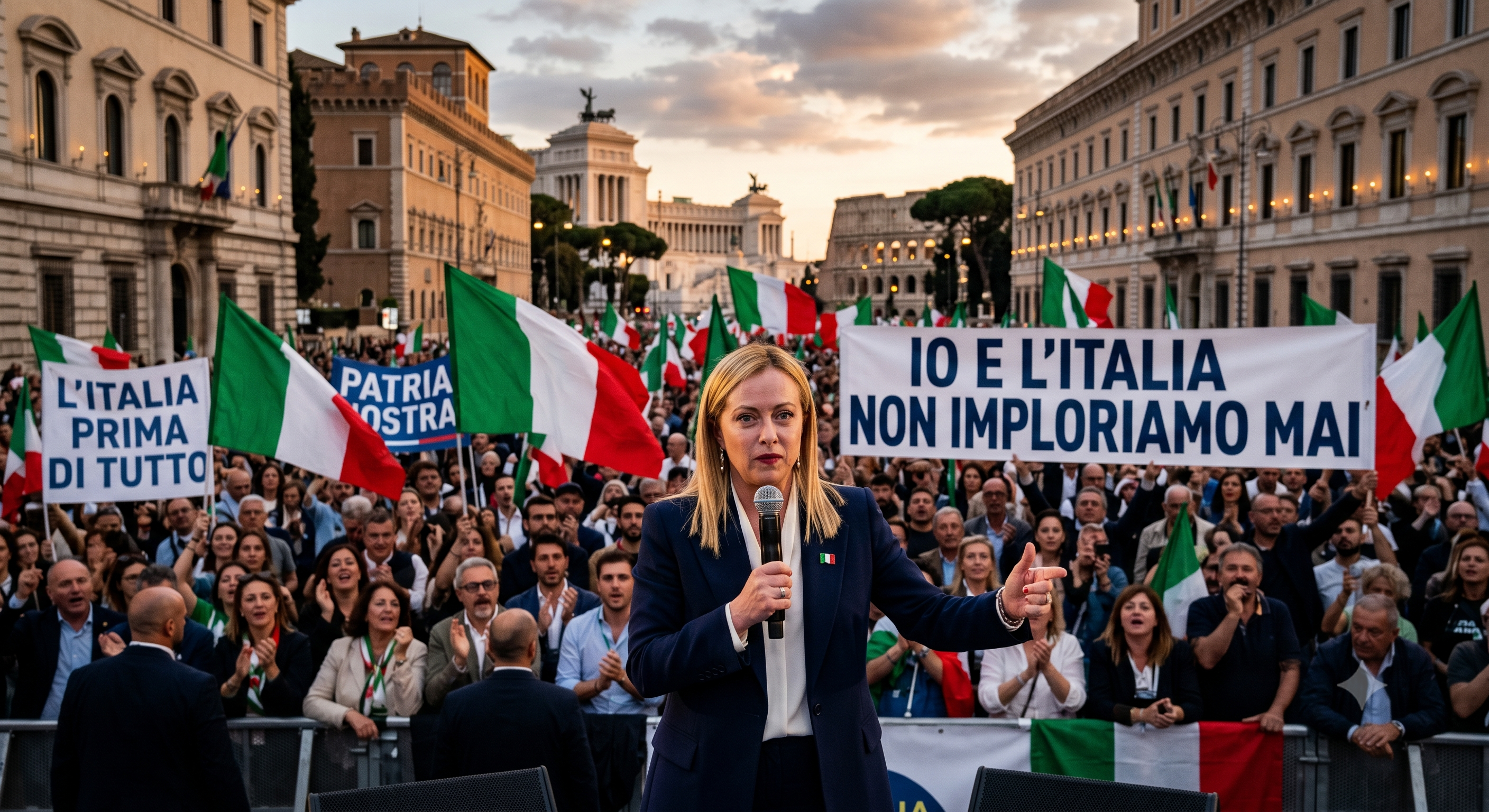
G7 Évian-les-Bains · June 2026 · "Io e l'Italia non imploriamo mai."
The facts of the incident are not in dispute. At the G7 Summit in Évian-les-Bains, France, Donald Trump gave an interview to Italian broadcaster La7 in which he claimed that Italian Prime Minister Giorgia Meloni had sought a photograph with him and had, in his words, effectively pleaded for the opportunity. He described the experience as making him feel sorry for her.
Meloni's response was immediate, public, and unambiguous. In a video posted to her Instagram and X accounts — watched by millions within hours — she described Trump's claims as "completely made up" and said she was "stunned" by them. She concluded with a line that has since become the defining phrase of the episode: "Io e l'Italia non imploriamo mai." I and Italy never beg.
Italy's Foreign Minister Antonio Tajani cancelled a scheduled visit to Washington. President Sergio Mattarella expressed solidarity with Meloni. In an unusual show of national unity, both government and opposition parties aligned behind her response.
"One of them is not telling the truth. That is not a minor detail for an alliance whose entire architecture rests on the assumption that partners say what they mean and mean what they say."
The Question Every Ally Is Now Asking
In the immediate aftermath, commentary focused on the personal dimension — the awkwardness of a public dispute between two leaders who had, until this week, been characterized as ideological allies. That framing misses the structural significance.
Meloni is not an adversary. She is among the most aligned European leaders with the current U.S. administration in terms of political orientation. If this is how the relationship with a friendly, aligned ally is characterized — publicly, in a media interview, using language that questions her dignity — then every head of state traveling to Ankara on July 7 is processing the same question: what would be said about me?
This is not paranoia. It is rational alliance calculus. Trust in a collective security arrangement is not a sentiment. It is an operational requirement. Partners share intelligence with allies they trust. They coordinate military planning with partners whose word they can rely on. They make binding commitments — including Article 5 commitments — with counterparts whose public statements they believe reflect reality.
Who Do You Believe?
The factual question — did Meloni seek the photograph or not — is, in one sense, unknowable from the outside. Both parties have stated irreconcilable positions. One of them is not telling the truth.
But the question of credibility extends beyond the specific incident. Consider the broader pattern of the past week alone: Trump told G7 allies "I'm the boss." He told Axios there are "no limits" to his power. He told an Italian broadcaster that a G7 partner "begged" for his attention. Meloni — whose country has been one of the administration's most consistent European supporters — called his account "completely made up."
The allies sitting in Ankara on July 7 will have read all of this. They will be making their own assessments of which accounts to credit, which commitments to weight, and which partner's word to rely on when the stakes are higher than a photograph.
Dignity Is Not a Soft Variable
Meloni's response identified something important that purely military analyses of alliance health tend to underweight: dignity. "Io e l'Italia non imploriamo mai." Italy never begs. This is not a statement about defense spending or force posture. It is a statement about the terms on which a sovereign nation participates in a collective arrangement.
Allies who feel diminished, misrepresented, or publicly humiliated by a dominant partner do not simply absorb the experience and continue as before. They recalibrate. They share less intelligence. They cooperate more selectively. They make bilateral arrangements outside the collective framework. They say yes in public and hedge in private. None of these responses are irrational — they are the predictable result of a trust environment that has been damaged.
The cost of that recalibration is not measurable in defense spending percentages. It is measured in the quality of collective action when it matters most — when the alliance is called to respond to a genuine security crisis and the question is not whether members are spending 5% of GDP, but whether they trust each other enough to act together without reservation.
What Ankara Must Address
The Ankara Summit will produce communiqués about capability targets, force posture reviews, and spending commitments. These are necessary and important. But the most consequential thing that happens in Ankara on July 7–8 will not appear in any communiqué. It will happen in the bilateral meetings, the corridor conversations, and the private assessments that every head of state makes about whether this alliance — as currently constituted, under current management — is one they can genuinely rely on.
Security requires trust. Trust requires honesty. Honesty requires that when a partner says something is "completely made up," the alliance has a framework for taking that seriously rather than dismissing it as political noise.
Someone is not telling the truth about what happened in Évian. That question will be in every room in Ankara. The answer — and the alliance's ability to function despite the uncertainty — is the real test of what NATO 3.0 actually means in practice.