"I'm Going for Erdogan": What Trump's Oval Office Statement Reveals About NATO's New Architecture
In the Oval Office on June 24, with NATO Secretary General Rutte at his side, Donald Trump made a statement that no U.S. president has made about a NATO summit in the alliance's 77-year history: he was attending not because of collective commitment, but because of one leader's personal request. The implications for what NATO has become — and what Ankara will reveal about its future — are significant.
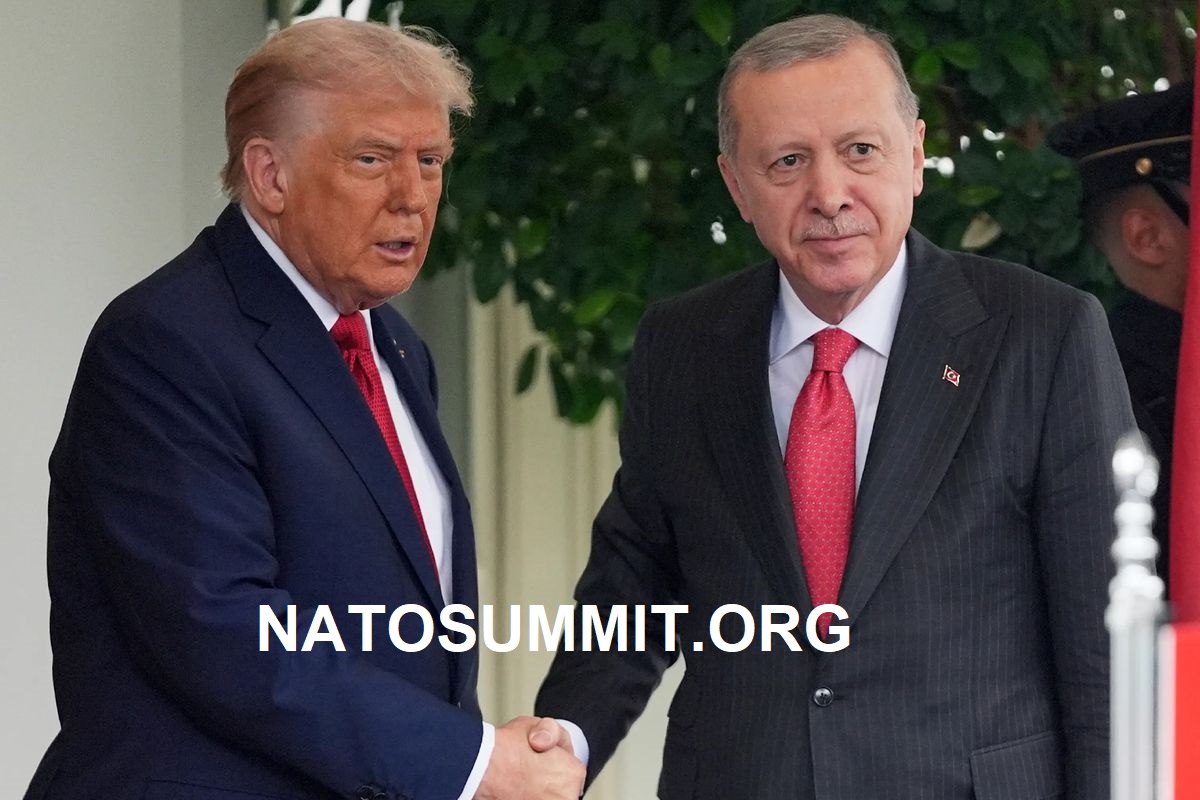
Trump · Erdogan · Washington D.C. · September 2025 · natosummit.org
What Was Said — Oval Office, June 24, 2026
"I am going to the summit out of respect for President Erdogan. Except for the fact that it was being held in Turkey by President Erdogan, I don't think I would have gone to it."
— Donald Trump, Oval Office
"I just want their loyalty. We don't need their money, we don't need anything."
— Donald Trump, on NATO allies
"He's been a friend of mine. He was a prime candidate to go into the war with Iran, maybe on the Iran side, but he stayed out."
— Donald Trump, on Erdogan
"Without Türkiye, Trump wouldn't come to NATO summit."
— FM Hakan Fidan
The Oval Office meeting on June 24 between Donald Trump and NATO Secretary General Mark Rutte was, by the standards of alliance diplomacy, unusual in several respects. Rutte arrived with charts on easels — large gilded displays titled "Trump Trillion" and "Trump 47 Effect," built around figures designed to show Trump's positive impact on NATO defense spending. The presentation was reportedly tailored specifically to Trump's preferences: visual, data-heavy, and flattering.
Trump's response to Rutte's presentation was warm. His statement about Erdogan was something else entirely.
"I am going to the summit out of respect for President Erdogan," Trump told reporters. "Except for the fact that it was being held in Turkey by President Erdogan, I don't think I would have gone to it." He elaborated: "I would go for you [Rutte]. But I wouldn't go for most people. But he called me. He said: 'Please, it is being held in Turkey. You should be there. The United States should be there.' And that's why I'm going."
"No U.S. president has publicly framed attendance at a NATO summit as a personal favor to one ally's leader. The statement redefines what the summit's legitimacy rests on — not collective obligation, but bilateral relationship."
The F-35 Signal
The most consequential element of the Oval Office exchange may not have been the Erdogan statement — it may have been what Trump said when asked whether he was traveling to Türkiye with a "big gift bag," in reference to Ankara's long-standing request for F-35 fighter jets. Trump's reply: "Yeah."
That single word, if it translates into a concrete offer in Ankara, would represent one of the most significant shifts in U.S.-Turkey relations in years. Türkiye was removed from the F-35 program in 2019 after purchasing the Russian-made S-400 air defense system — a decision that triggered sanctions under CAATSA and created a seven-year rupture in one of the alliance's most strategically important bilateral relationships.
The implicit offer of F-35s arrives in a specific context. Erdogan personally asked Trump to attend the summit. Erdogan stayed out of the Iran conflict when Trump asked him to. Erdogan has met the NATO spending target. Erdogan is hosting 32 heads of state in Beştepe on July 7. The "gift bag" — if it materializes — is not NATO policy. It is the return leg of a bilateral transaction between two leaders who describe each other as friends.
What "I Just Want Their Loyalty" Means
Trump's formulation of what he expects from NATO allies — "I just want their loyalty. We don't need their money, we don't need anything" — is the clearest statement yet of the transactional framework through which he views alliance relationships. Money, capability, force contributions, Article 5 commitments: these are not, in this formulation, what matters. Loyalty is what matters. Personal, bilateral, demonstrated loyalty.
Erdogan has delivered loyalty on the specific terms Trump values. He stayed out of the Iran conflict. He took Trump's calls "several times over the past month" according to FM Fidan, and confirmed attendance on each occasion. He organized a summit — the most visible diplomatic event of the year — that gives Trump a stage and an audience. He managed the S-400 issue without becoming a public confrontation. He is, in Trump's own words, "a friend."
The 31 other NATO allies are calculating what this means for them. Several denied the U.S. overflight during the Iran war — Hegseth called them "shameful" in Brussels. Several have not met spending targets. None of them called Trump personally and said "please, you should be there." The bilateral loyalty framework does not distribute evenly across 32 members.
Rutte's "Trump Trillion" Strategy
Secretary General Rutte's Oval Office presentation deserves its own analysis. The "Trump Trillion" and "Trump 47 Effect" charts — large, gilded, designed to credit Trump personally for the increase in European defense spending — represent a deliberate institutional strategy: frame collective alliance achievements as the direct consequence of Trump's individual leadership, in order to maintain his engagement with the alliance.
It is a strategy that has worked, up to a point. Trump did not withdraw from NATO. He did attend — after Erdogan called. The "Trump whisperer" label that diplomats have given Rutte reflects genuine skill at managing a relationship that most institutional actors would find impossible to navigate.
But the strategy also reveals the fragility of the current arrangement. An alliance whose most powerful member's participation depends on a combination of personal flattery, bilateral friendship with the host, and gilded charts is not operating on the same foundational logic as the alliance described in the Washington Treaty. It is operating on something more personal, more contingent, and considerably less predictable.
What Ankara Will Reveal
The Ankara Summit opens in 12 days. Trump will be in the room — because Erdogan called him. The F-35 signal will either materialize into a concrete offer or it will not. The communiqué will be drafted, negotiated, and issued. The alliance will present itself as unified.
What Ankara will actually reveal is whether the architecture that holds NATO together in 2026 — personal relationships, bilateral transactions, carefully crafted presentations — is durable enough to produce the concrete security commitments that the alliance's eastern members, Ukraine, and the broader democratic world are counting on.
Collective security built on one leader's personal loyalty to another is not inherently weak. But it is contingent in a way that Article 5 was designed not to be. The question of July 7–8 is whether the personal becomes institutional — whether Erdogan's friendship with Trump translates into alliance deliverables that survive beyond the relationship itself.
Turkish Foreign Minister Fidan put it plainly: "Without Türkiye, Trump wouldn't come to NATO summit." He is right. And that fact — more than any communiqué language, more than any spending target, more than any force posture announcement — is the defining diplomatic reality of the 2026 Ankara Summit.